Tuesday, April 22, 2014

Jon’s latest South Sudan Phone Update - April 10, 2014

It was so good to hear Jon’s voice on April 10, 2014 he was upbeat and honest about how busy they have been, stating over and over how he has his struggles and burdens, but how much he loves it there & that God is good through it all! 

SURVEYING THE LAND - They have been very, very, busy,  spending extensive hours each of the past 8 days doing necessary survey work on the farm (Arco) with a gentleman, named Brian McKay, who is a part of the team that went over in March. Jon says that every day they tromp over miles of farmland, which he says is massive and so beautiful, and he hopes will one day be the place of his future home.  They had almost completed walking the outer boundary after all these days and now they will spend another week or more, walking it yet again, pounding boundary stakes in as they go. He said, “I am not complaining mind you. I absolutely love it. I feel like I’m back in Disaster Relief Training, as we’re in the wilderness, miles from the nearest person, with a 40 lb. back pack trekking in and out daily.  Brian has been training Jonathan and another young man, to use the surveying equipment asking them to lead the way and figure it out. 

BRICK PRODUCTION has waned because of the current political upheaval in the north of South Sudan and it’s effect on economic development, but Jon said they recently made some contacts that were interested in bricks. PRAYing for the Lord, to order this, bringing forth business and the the provision for needed materials and all that is needed to go forward. 

They were not able to purchase DRIP IRRIGATION SYSTEM before heading to South Sudan, but Jon feels that is God ordering their steps as the surveying is consuming alot of their time and the wet season is starting. 

He asked us to PRAY that God would provided for three things:

1.)  The training course he & Roger want to take June 22-27. EQUIP International in NC. offers a week long intensive called Farming God’s Way, taught by missionaries who have farmed and methods of drip irrigation in 3rd world countries, in hopes that he can learn more about it before he returns in late summer or early fall, as the Lord leads. 

Farming God's Way/Intro to Foundation for Farming This is a course in which the principles Foundations for Farming and Farming God's Way begun by Brian Oldreive in northern Zimbabwe will be presented... The use of various forms of drip irrigation will also be discussed.  While these methods will be covered, basics in agriculture will be the emphases for the class because it is of vital importance to understand the nutritional needs of plants and the conditions needed for them to flourish.  The participant will leave with a better understanding of not only how to grow food, but also how to integrate the information into a method of Christ-centered discipleship.

2. The needed DRIP IRRIGATION equipment to set up a trial area of the farmland before the dry season in October.

3.) PRAY also for more permanent workers on the farm (Jon would like to be one of them) as they need dedicated people to work the farm on a regular basis.

Jon also finds that people come to him for basic medical attention and as Robert Kirkman said, First World medical training does not adequately equip you for the needs presented to them in South Sudan and he has a background as an EMT. Jon and Robert Kirkman hope to be in the US for the late October(19 - 31)  Missionary Medical course through EQUIP International so they can be more appropriately equipped to help as needs arise. Thank you for PRAYING for the Lord to order their steps and provide, so they can follow through on this training.
MMI is a two-week course designed to equip missionaries with diagnostic skills and appropriate treatments. MMI enables the missionary to do physical exams, and to process the information gathered to come up with an accurate diagnosis, and a recommended treatment.

Something to PRAY for is on Wed. evenings, William has begun a discipleship course of FOUNDATIONS IN THE FAITH & the Word & lots of people are coming.  The need for a strong foundation is great in a country that has been ravaged by war & families surviving in refugee camps. Now God has them in a more stable place where they can grow in Him. 

We will be setting up a speaking itinerary for after Jon returns, Memorial Day, May 26.  If you would be willing to have us, as a family or with William & his family, to share at your church or if you would be willing to host us sharing with some of your friends in your home, please let us know!

In him Who keeps us, Roger, Patty & Emma


PS. We happened to call last night (4/14)  to ask William a question and Jon answered and said a number of things had happened to make it a particularly difficult day. So thank you for your continued prayers for all there in Borongole. So thankful we could pray with him and entrust all into God’s sovereign care.    www.operationsnehemiah.org

2nd Trip ~ Episode 13: Foraging, A Multi-Generational Skill

Ingoni Everyone!                                                                  

    With less than two weeks until my return to Africa, reality is
beginning to set in and I am getting excited! I can't wait to get back to
Borongole and the adopted African family that are my dear brothers and
sisters in the Lord. The next two weeks will be full of personal study, speaking engagements, last minute shopping, packing, and fellowship with
friends before I leave. 
     I appreciate your prayers for all the preparations that need to fall into place. Please pray also for the Levi's, as there is much they are waiting on the Lord to provide before they leave as well, and much that needs to be done as you pack up a family of 8. God has been so faithful in the past, we trust Him to order all of our steps.

     In past episodes I have mentioned the resourcefulness of the people of South Sudan. While I was there, I observed a clear example of this resourcefulness in the use of native plants and trees for a multitude of uses. Taking a walk in the bush wasn't just exercise and exploration, but a nature lesson.

    On a trek through the bush with William Levi, founder of Operation Nehemiah, I was blown away! Every few minutes he would point out a tree or bush with incredibly practical uses.    
   "This is the Alwa tree which we gather oil from."
    "When the bark is peeled of this small tree, you can use it for rope!"
    "Mothers will wash babies in the water soaked with this plants leaves."
   You would stumble upon wild Aloe (hopefully not literally, they have thorny spines!) and encounter different varieties of wild fruits that would satisfy hunger and quench thirst very effectively. On my first trip I remember a four hour hike I took with men from our village. We didn't bring breakfast or lunch with us into the Bush, instead feasting on a yellow, Cherry-tomato-shaped wild fruit called Esu. It had a delicious tartness to it and fully satisfied me until my late evening meal, several hours later.
   Several staple South Sudanese dishes come from wild edible plants out in the bush. I would frequently see my adopted mama and sisters walk out of the village with gathering baskets on their heads. An hour later those baskets would be full of wild greens or bean pods. On those days I knew I could look forward to a delicious meal of Asobi or Cheroko for dinner.
     Another great example is the African tooth brush. From the bark or stem of a few different species of tree are natural chemical components which will clean and whiten your teeth! These varied kinds of trees are very common and you are able to brush your teeth wherever you are. The people of South Sudan have the whitest and straightest teeth I have seen and many people primarily use these "natural" toothbrushes. A stick or piece of bark is more efficient and available than any tube of "Colgate" that you could buy at the store!

    William and his older siblings came from a generation that were raised in South Sudan before the war. Childhood was full of sustenance agriculture, hunting, and animal raising with their families. They grew up being educated in the wilderness lore and woodcraft that has been passed down for generations.
      Fast forward to those 30 years old and younger. Before and after they were born, resurgences of warring violence chased their family into exile. Growing up in refuge camps in Uganda gave no opportunity to learn knowledge of foraging and the natural resources here that are so helpful.
   
     As I reflected on this it became clear that in a few generations this knowledge and skill will be lost. The younger generations of South Sudan would be losing a wealth of information, which would be a great shame and put them at a disadvantage. This concern has grown, in both myself and William, a desire to preserve this natural heritage. Beginning this trip, we will begin to record, study, and document the various foliage and flora, along with its practical uses. The long term goal is to have a field guide specific to South Sudan, where the use and knowledge of useful native plants, trees and shrubs can be passed on to the future generations of South Sudan.


    "And the Lord God planted a garden in Eden, in the east, and there he put the man whom he had formed. And out of the ground the Lord God made to spring up every tree that is pleasant to the sight and good for food...  The Lord God took the man and put him in the garden of Eden to work it and keep it."
                                                                                 Genesis 2:8-9a, 15


Rubanga Cola nito (God be with you)!

~Jonathan Lueken with Operation Nehemiah 

2nd Trip ~ Episode 12: The Bend in the Trail and Path Beyond


Ingoni! Nichwi? (Hello! How are you?)

   It is a chilly, but beautiful day here in New England. I was incredibly blessed this week to purchase my airline ticket for the trip to South Sudan on March 23rd. Today (Friday) was the final deadline and as of Tuesday I had only half of the amount. That very morning I received a letter and a gift from someone in Afghanistan that covered what I thought was the full price. 
   Two days later, I began the process of purchasing and realized I was still short. God already had it covered and unbeknownst to me, an anonymous person had given an unexpected gift which they left at a church I recently shared at. It covered the remainder of the cost and was a reminder of God's faithful provision wherever He is leading us. Where the Lord guides, there He provides.
   Please pray for:
   -The ability to purchase and bring over a Drip Irrigation system which will enable cultivation in our farmland to continue all year round.
   -The needed trip expenses (visas, fuel for the vehicles picking us up from the Ugandan airport, accommodations during travel, and personal gear needed on the ground) for the two months for myself, the Levi's and Surveyor Brian McKay who will be a part of the team.
   -Donated goods and items to bring with us for the people of Borongole (our village). We will be receiving these until our departure.

    Two trips and six months in Africa has already taught me a lot. As I discovered the needs and work to be done in South Sudan, it was a time of  personal exploration and discovery of the place where God has directed me.  

    As I grew up I often wondered what I would do and where I would be as an adult.  Being home schooled, I would do extensive research on prospective careers and jobs. This often lead to confusion as each possibility never had the full scope of the various interests and desires I had been given. With a love of the outdoors and physical exercise, a desire to do both agriculture and wildlife study, a deep interest in history, and a God-given yearning to serve Him with my life, I was often perplexed. Was there such an occupation or place that encompassed all these things?
     Certain paths and opportunities would open before me, which included Disaster Relief training and a Bible training, however, the bigger picture was still around the next corner. 

    Living and working among the South Sudanese was where the light went on. I realized that my whole life I had been prepared for long term work in Africa and I was more suited to living in a rural African village than back in America. All the training, reading, and learning opportunities shaped me for a life I could have never anticipated. 
   I have the opportunity to be involved in agriculture on a regular basis (see "Episode 9: A Day on the farm") and enjoy invigorating hard work and extensive "footing" around with my South Sudanese brothers. And we are always outdoors except when we sleep or when it rains.
   The flora and fauna of S. Sudan is beautiful and abundant, with much room for recording, studying, and documenting the wildlife for the next generation of Africans (we will begin documenting local plants and trees this trip, so that those who have lived in refuge camps will have the knowledge of the various uses of edible plants, etc. that previous generations have known). 
   The Nehemiah Lighthouse conference center project will be highlighting and rediscovering the history of that region and there is the daily opportunity to share the good news of Jesus Christ on our gospel radio station. 
   The people who I have the privilege to live and work alongside are the most kind and grateful I have ever met. I now consider each one in our village to be my own brothers and sisters and have been unofficially adopted into Pastor Michael and Katherine's family (William Levi's brother and sister-in-law). I am very thankful to see how God placed these desires in my heart, had a plan long before I knew of it, and was preparing me the whole time.

 "There are secret and invisible things that God makes known to waiting souls.."
                                                                            Thomas Manton

   This all sounds very wonderful, but I have already seen that having a very fulfilling work is not necessarily an easy one. Life anywhere is not a bed of roses (or maybe it is since roses have thorns!). In my previous trips, I have experienced more difficult physical, emotional, and mental challenges than anywhere else. I have had work days of brick production where I felt I was receiving a military smoking (punishment by insane exercise). Tears have come to my eyes at the tragic loss of both young and old. Seeing blatant corruption and greed causes deep frustration. Many of my beliefs were challenged by what I saw and I had to dig deep in study and prayer to solidify the truth in my own heart. I was grieved by observing negative influences and the violence that are coming into the communities of S. Sudan and it has had me on my knees before the Lord Jesus, the only One who can reverse them.
    
   South Sudan is a place of great problems and great potential and only Jesus can meet all the physical and spiritual needs that are present. I am just thankful to be following the path that is set before me and walking it with my Lord and Savior. 

      "Jesus said, “Truly, I say to you, there is no one who has left house or brothers or sisters or mother or father or children or lands, for my sake and for the gospel, who will not receive a hundredfold now in this time, houses and brothers and sisters and mothers and children and lands, with persecutions, and in the age to come eternal life."                     Mark 10:29-30  


2nd Trip ~ Episode 11: When treatable illness goes untreated

Ouida (Good Morning) Everyone! 

    I hope you are all doing well. I was blessed this past week to receive a clean bill of health from the doctor and will not have to deal with Hepatitis A again. It has been nice to resume normal exercise and other activities, including the availability to travel and share about South Sudan. 

      I often reflect on how as an American, I take health for granted. Here we have medical aid a cellphone call or short ride away. The common illnesses which affect us on a daily basis are the flu and the stomach bug. The options for medicine are abundant and can be available anytime of the day or night. We should be very thankful!
      The stark contrast is clearly seen in third world Africa. The seriousness of the common diseases, such as Typhoid, Yellow Fever, Hepatitis (Both A and B) and Malaria were both felt and seen by myself. In four months time I would contract 
Malaria at least twice and was more seriously ill than I have ever been. In a two week period, eight different individuals from our village in South Sudan had Malaria or a combination of that with Typhoid! 


     There was an incredibly sad and sobering occurrence which illustrates this great need. I became buddies with seven or eight year old Wani. I spent many afternoons practicing my futball skills, trying to keep up with my South Sudanese 

friends, who are all world class soccer players. During these practice sessions Wani would come along and I found that he could play circles around me! Along with his younger brothers, we would often play together and I so enjoyed his energy and enthusiasm. He was a hardworking little boy and very active in the Church's choir and also loved Jesus.

    In the month of December I heard that little Wani had come down with what they thought was Malaria. His family struggled to get the proper tests and were only able to treat it cheaply, as a mild case. Two days later little Wani was deathly ill and rushed to the hospital 45 kilometers south. Coming back from a futball match one evening, my friend Gabriel told me the awful news. At the hospital, they discovered the illness was yellow fever and by then it was too late. He died three days after succumbing to the disease. It really broke my heart. 
   Funerals in South Sudan are very long and require a lot of formal family discussions over arrangements, many lasting over a week. Extended family members and friends will camp out for several days. I felt deeply for the mother who was continually reminded of the loss by an African grieving tradition. Every time any woman approached the grave to sympathize, she would give a piercing, sobbing wail. Many people showed up a week after the burial and those expressions of grief must have been very hard for Wani's mother to hear continually.

    In 2005, Operation Nehemiah established a Medical Clinic in Borongole. Over the years we had three different doctors trained and who worked there for a short while, but eventually were all drawn elsewhere. At the time of this sad event, our clinic had been unmanned and unequipped for the needs there. The nearest clinic was a mile away and had only limited resources. 
     The importance of having free diagnostic testing for common diseases and emergency medical care in our village is vital. One of the thrusts of the coming March thru May trip will be to get the clinic established and running. Already three men from the village have been sent to receive month long medical training and will help start up the medical care under the eye of the public health officer by April.  With guidance from the Lord and much prayer, we are committed to keeping our community from giving up needed medical assistance because of poverty or want. No one should die of yellow fever! 

   Please pray for:
      
   1. For this coming trip, as are looking to supply them with Rapid Diagnostic Kits, a Microscope for testing, medicines and First Responder/First Aid supplies from the United States. 

    2. We also need to replace our ambulance in order to provide transportation to the regional hospital for those requiring critical care. Our ambulance, purchased in 2003, is no longer road worthy. We want to purchase an “E-Ranger” (Motorcycle with sidecar) from South Africa. 80% of the people in Eastern Equatoria live in remote areas with no roads. An E- Ranger vehicle would provide accessibility to these areas, enabling us to provide them with on-site emergency care and transportation.

     Thank you for your support and prayers!   "... pray for one another, that you may be healed. The effective, fervent prayer of a righteous man avails much." James 5:16


2nd Trip ~ Episode 10: A Day on the Farm


                                                                                                                       Sept 2013- Jan. 2014
    The village Farmland is in the bush, 5 or 6 miles from the village of Borongole. In the last several months it has become my favorite place in the world! After bumping along a rough African bush road (if you are driving), you come to a ford crossing a small stream and are welcomed by a sign to Beth Israel Farmland. Continuing on, a small field of sorghum with interspersed banana trees appears on the right. Fairly soon, the water tower to the Solar powered Well comes to view and the smell of Orange blossoms and Mango trees greets you. This is Arko (Madi word for farmland or Garden)! Since, the work on the block making was very time consuming, I didn't have any opportunities to visit this beautiful place until the first week of this new year.

   On that day I accompanied my good friend Deziga, the tractor driver, and his wife Annette for a day out in the field.  That morning, striking white clouds were displayed on a vividly blue sky, as the faithful tractor rolled out of the village and drove 5 miles towards the Garden. God blessed us with a beautiful day and the weather was truly perfect. 
    The first crop of the day was bean pods harvested from a wild edible green, called Asobi. We hand picked these and collected them in a sack. These little beans are made into a sauce that looks like split pea soup and is quite delicious. While Deziga and I dug up Cassava, Annette was cooking our lunch right there in the bush over a small fire. The resourcefulness of these people often astounds me. Using cooking oil, salt, an onion, a tomato, and some pasta she made a sauce which was poured over rice. Though not necessarily healthy, it was tasty and filling, especially after hand-excavating the starchy tubers of the cassava plant. Three of us shared a lunch using the African fork, our hands.
    The next crop was a smaller variety of Sorghum called Sorenna, a main ingredient in a few South Sudanese breads. This plant grows only four feet tall while normal Sorghum can reach 12 feet! It took two hours for our trio to cut the tops of 
the stocks and fill the large bag with the laden seed heads. Before heading home small acreage was plowed up and a snack of cooked Cassava was had.
  
   It is true that we spent quite a few hours in the hot African sun and did some hard physical labor which can tire you out. We also needed to jump the tractor 3 times with a battery brought for that purpose. Some people might think this to be a hard and taxing day. 
   I found it to be one of the most relaxing days ever and enjoyed some great conversation as we all worked together. This lifestyle is simple and the majority of the food comes directly from the soil. An agrarian society might be considered backward in this fast moving and technologically advanced, 21st century America, but I am not so sure that is true. The hectic days and worry over our many possessions seems to cause a multitude of health problems here, even though we have access to every medicine possible.
   It is true that South Sudan could really use many helpful technologies that would improve medical care, sanitation, etc. However, it seems to me that a simple life of growing and raising your own food is the way God intended it to be and something we can move towards. 
      "And God said, “Behold, I have given you every plant yielding seed that is on the face of all the earth, and every tree with seed in its fruit. You shall have them for food. And to every beast of the earth and to every bird of the heavens and to everything that creeps on the earth, everything that has the breath of life, I have given every green plant for food.” And it was so."   Genesis 1:29-30

   I find God's balance in the words found in Proverbs 30:7:
     "Two things I ask of you; deny them not to me before I die: Remove far from me falsehood and lying; give me neither poverty nor riches; feed me with the food that is needful for me,
lest I be full and deny you and say, “Who is the Lord?” or lest I be poor and steal and profane the name of my God."

     The crops I described above were the last crops to be harvested as the dry season was setting in. The reason they were the last, is that though there is a water source, we have as yet no drip irrigation to enable cultivation in a season that doesn't receive a drop of rain. Many people in South Sudan find themselves at a shortage of food because many of the staple vegetables, starches, and legumes are unable to survive in the parched soil.
    One of the goals in this coming trip is to install a drip irrigation system in our farm. I will be directly involved in this project and our desire is to give these families the ability to feed themselves and also provide a source of income all year round. We are now raising funds to bring a complete drip irrigation system with us, which I will be helping to install once I get on the ground. 
      Please be praying for:
     ~The Drip Irrigation project, that we would be able to bring all that is needed over and have the wisdom, knowledge, and ability to install it properly.
     ~The people in our village and surrounding community will struggle this dry season, as an extended rainy season inundated our fields and caused staple crops like Cassava and Peanuts(groundnuts) to take a big hit. 2/3 of the cassava was rotted by excess rain! This means that some of these foods may need to be purchased from Uganda. I know that God will provide for all their needs according to His riches and glory.


2nd Trip ~ Episode 9: A Close Shave, Sudanese Style

 Sept 2013- Jan. 2014  
We are all probably familiar with the saying, "Expect the unexpected." This saying is especially true in Africa, applying to situations both big and small. I learned this lesson in a rather small thing, but it was humorous and humbling at the same time.


     After two months of living in our village of Borongole, my hair was getting a bit long. Making heavy-duty physical labor, under the African sun, hotter than usual. I asked my fellow missionary and co-laborer, Robert Kirkman, to give me a military style hair cut, short, but not too short. Trouble was encountered when his battery-operated trimmers wouldn't cut it (haha). My South Sudanese friend, Irahma, offered his heavy duty buzzers and said he would finish the job. I requested that he leave some on top and then sat down for the most painful hair cut of my life. While gritting my teeth and my eyes closed, I thought a hedge trimmer was being used on my head. Evidently, my hair is pretty thick and tough because Irahma kept saying "Tee Bee Okpwo!" (Hair is hard or strong!)

    In the African concept, no region of hair is shown partiality and all hairs are created to be equally.... shaved off. Half way through I took a break from gritting my teeth, opened my eyes, and asked for a mirror. There I beheld half of my head almost completely shaved! By that time it was just a matter of waiting while the other half was made level. I now had a very tan face and a very white head, which had not been exposed to the sun to such a degree before.
    Peoples comments were mixed. Some said I truly looked African and my adopted S. Sudanese father and mother said, "We now can really call you our son, because you look like one of our children". Most others laughed or asked, "Who spoiled your hair?" A friend of mine and one of our radio presenters said that he could't help laughing every time he saw me.

    Leading up to that incident, I was taking pride in my appearance. My African tan and the physical fitness I was gaining from hard work and frequent soccer games was beginning to fill my head. I needed to be humbled in order to get the right perspective.
     I learned an important lesson: Taking pride and finding satisfaction in our appearance is a dangerous thing, as it can be changed in the blink of an eye. These things are very shallow and will not last. They can be taken away in any number of circumstances. 
     Pride will puff us up and make us feel good for a little while, but we will be deflated quickly. I realized that life is not about ourselves, but how God can use us to serve and bless others. Phillipians 2:3-4 declares the attitude that blesses others and is a blessing to us in the process:  "Let nothing be done through selfish ambition or conceit, but in lowliness of mind let each esteem others better than himself.  Let each of you look out not only for his own interests, but also for the interests of others."
    Humility is a lesson that keeps us safe and satisfied in God. I needed a funny looking haircut to remind me that it's not about me.


Monday, April 21, 2014

Episode 8: A Zeal for God’s House


        A warm summer greeting to you!  This will probably be the last African Adventure for awhile, at least until I come back from my fall trip, departure date to be determined.  

[JON LEFT SEPT. 20, 2013 WITH A ONE WAY TICKET W/ ROB KIRKMAN TO WORK ALONG SIDE THE MEN OF BORONGOLE IN THE BRICK MAKING ENDEAVOR MENTIONED ABOVE. THE MACHINE’S ARRIVAL HAS BEEN DELAYED, SO THEY MAY NOT ACTUALLY START THE BRICK MAKING UNTIL NOV. BUT THEY HAVE BEEN VERY BUSY PREPARING THE LAND, BY CUTTING DOWN TREES, REMOVING ANT HILLS, ROCKS & 8 FOOT SUDAN GRASS & MOST IMPORTANT BUILDING RELATIONSHIPS.]


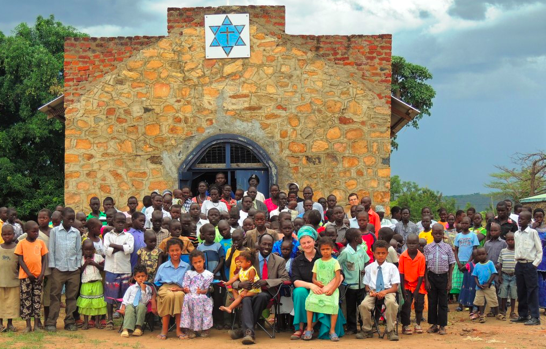
     Growing up in America I always thought that if church started later than15 minutes past the set time, it was a big delay. That was until I travelled to South Sudan & lived among a church community that runs on African time. I discovered that a starting time for the service is more of a guideline than an actual rule. The Beth Israel congregation would begin to trickle in around 10 AM. If the service started at 11:30 or 12 we were doing pretty good! "Better late than never" applies there in a real pertinent way. Even with the late start it was encouraging to see our small church building packed from front to back with families by the time corporate praise was lifted up.  Africans express their love for the Lord in a free and beautiful way. I don't think it ever crosses anyones mind what the neighbors in the other pew will think. From my vantage point, it seemed that only the Savior's opinion mattered. African praise songs and Hymns in Madi are sung acapella, accompanied by clapping & often joyful dancing before the Lord. It was natural to close your eyes as you joined in the worshipful chorus & be alone with Jesus.

     The hunger for the Lord is shone forth in so many ways. Testimonies given by people from the congregation, public prayers of healing & strength in trials for brothers & sisters in the Lord, generous giving with very low average income, & not wanting to leave the Lord's house! An average service lasted 4 hours & there was no rush afterwards to get to afternoon plans. Toddlers to seniors sat together for a few hours or longer. 
      An example of this is the day I was baptized with 34 others. There was a preparatory Baptism service, the Baptism itself & a post service which all total lasted for 7 hours. This did include a 2 mile walk one way to the Baptism site & by 5 PM, I admit, was getting hungry & a bit sore from sitting down. Going without lunch, I am sure many others felt the same way. Pastor Michael Levi explained that though peoples stomaches might be rumbling, there were some important things from God's word that needed to be covered & so we were going to continue. People value the Bread of Life so much that they will stay as long as it was being given to them. Our time always ended with some joyous singing & dancing. In case you were wondering, I did join in the dancing, though I had to throw aside my American respectability & be willing to look like a fool for the Lord (my african dancing isn't that good yet!).

    My prayer for myself & for us all is that we would have a zeal for the Lord that would surpass and suspend our own selfish desires.   Rubonga cola nito!  (God bless you!)   ~Jonathan Lueken